


Description
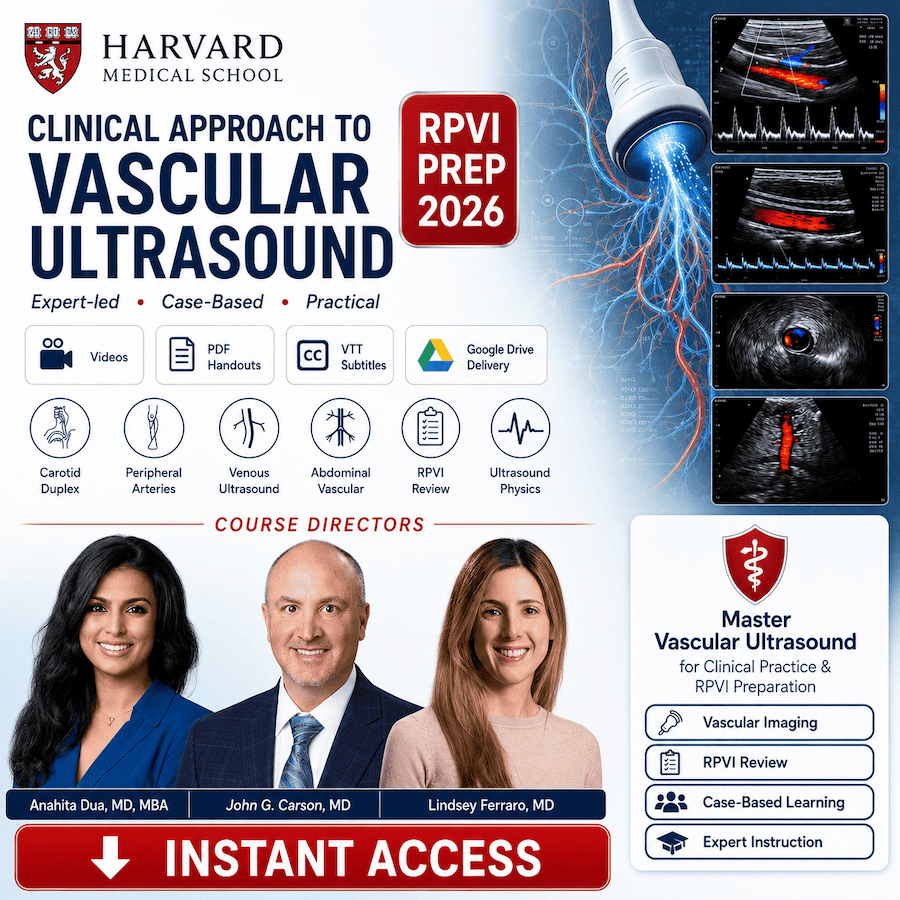
Clinical Approach to Vascular Ultrasound: RPVI Prep 2026
Build practical confidence in vascular ultrasound performance and interpretation. This expert-led, case-based program reviews arterial, venous, cerebrovascular and abdominal vascular studies while reinforcing the high-yield concepts commonly tested on the Registered Physician in Vascular Interpretation (RPVI) examination.
About This Vascular Ultrasound Course
This program is designed to establish a strong foundation in both the performance and interpretation of vascular ultrasound. The curriculum combines ultrasound physics, machine operation, velocity criteria, clinical interpretation and practical case presentations across the peripheral, cerebrovascular and abdominal vascular systems.
The lectures were developed with medical and technical leadership from major vascular laboratories, including Massachusetts General Hospital and Brigham and Women’s Hospital, with additional faculty involvement from Stanford University Hospital, the University of Colorado and Johns Hopkins Hospital.
By connecting technical concepts with real patient scenarios, the program helps learners translate vascular laboratory findings into clinically meaningful decisions. It also reviews high-yield material for the Registered Physician in Vascular Interpretation (RPVI) exam and addresses how to develop and implement a vascular laboratory program at a home institution.
Why This Course Stands Out
✓ RPVI-focused review — high-yield pathologies, diagnostic criteria and interpretation principles
✓ Case-based learning — practical examples that connect findings to real patient situations
✓ Post-intervention surveillance — bypass grafts, EVAR, dialysis access and deep venous arterialization grafts
✓ Technical foundation — ultrasound physics, machine controls and study optimization
✓ Clinical implementation — guidance for developing and operating a vascular laboratory
✓ Multidisciplinary relevance — suitable for physicians, advanced practice clinicians and ultrasound professionals
Learning Objectives
Major Clinical Areas Covered
🫀 Peripheral Arterial Imaging
Upper- and lower-extremity studies, bypass surveillance, tibio-pedal access, limb-preservation imaging and Pedal Acceleration Time.
🧠 Cerebrovascular Ultrasound
Carotid duplex, subclavian and vertebral studies, transcranial Doppler and carotid case interpretation.
🩸 Venous Ultrasound
Venous insufficiency, thrombosis, obstruction, pelvic congestion syndrome and office-based venous procedures.
🫁 Abdominal & Visceral Vascular
Abdominal ultrasound, renal and mesenteric artery disease, aortic endovascular graft surveillance and related velocity criteria.
Course Directors
Director of the Vascular Lab; Co-director of the Peripheral Artery Disease Center and Limb Evaluation and Preservation Program; Associate Director of the Wound Care Center.
Professor of Surgery and medical director of noninvasive vascular laboratories, with clinical interests in complex arterial disease, carotid disease, aortic pathology, venous insufficiency and limb preservation.
Course faculty member associated with Hudson Headwaters Health Network and featured in the supplied course materials.
Complete Curriculum — 29 Sessions
Who Should Take This Course?
Perfect for:
✓ Vascular surgeons ✓ Vascular medicine specialists ✓ Cardiologists ✓ Radiologists
✓ Primary care and specialty physicians ✓ Ultrasound technologists and vascular sonographers
✓ Nurses ✓ Physician assistants ✓ Nurse practitioners ✓ Allied health professionals
✓ Physicians preparing for the RPVI exam ✓ Clinicians developing or managing a vascular laboratory
Delivery & Access
📁 Google Drive Delivery
Digital course materials are shared through Google Drive for convenient access from compatible devices.
🎥 Multimedia Course Package
The package may include recorded lectures, PDF resources and VTT subtitle files. Exact file counts and total size should be confirmed before publishing.
📱 Flexible Study
Review technical concepts, cases and RPVI topics at your own pace on desktop, laptop, tablet or phone.
💬 Sample Available
Contact customer support to request a sample when available.
Important: This listing describes a digital educational course package. It does not claim live attendance, official enrollment, CME credit, exam eligibility, certification or guaranteed RPVI examination results. Confirm the exact number of videos, PDFs, VTT files, total size and product ID before publishing.


Reviews
There are no reviews yet.